

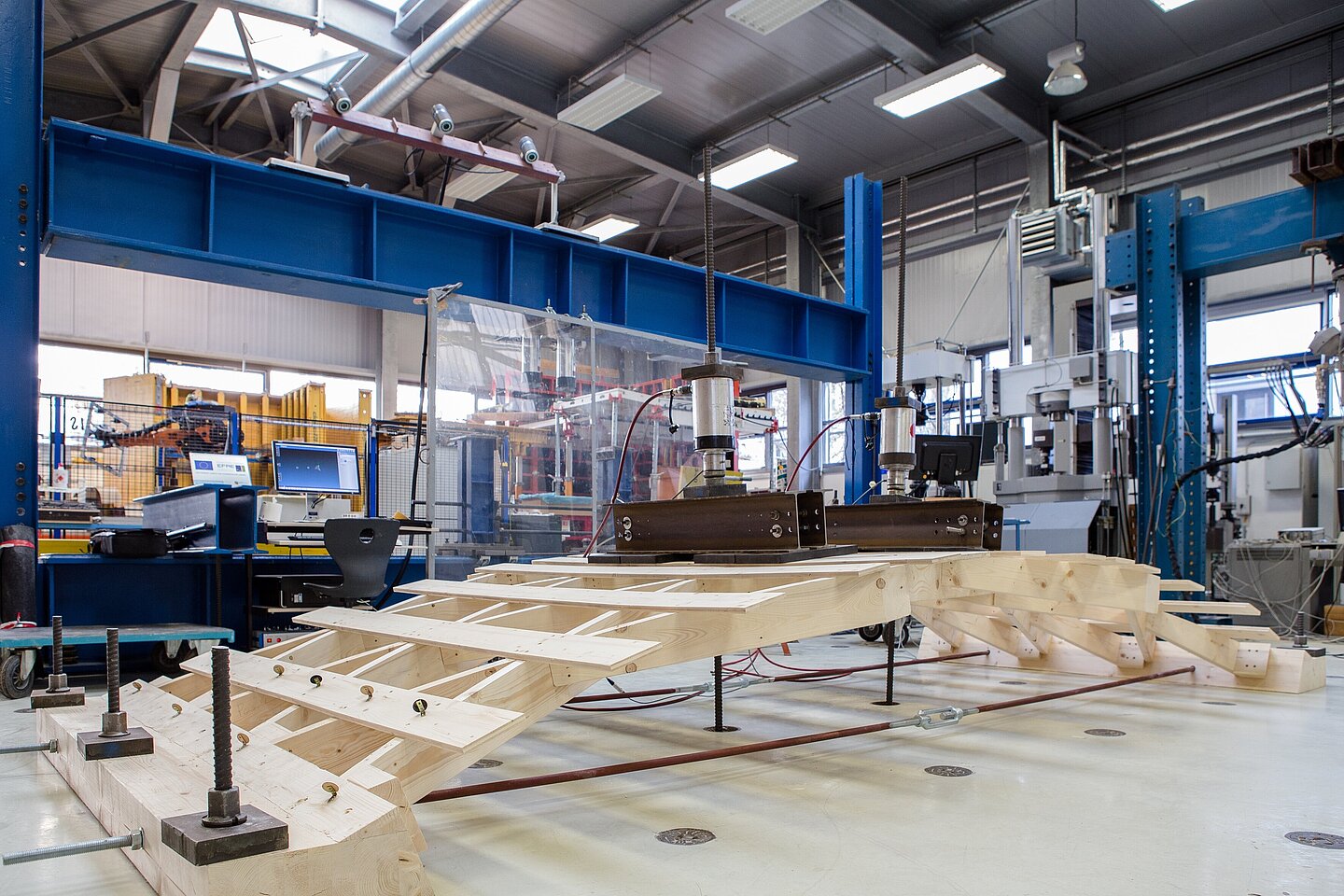
Large-scale load tests on entire roof segments in the test hall at HTWK Leipzig © FLEX@HTWK Leipzig, Lukas Franke
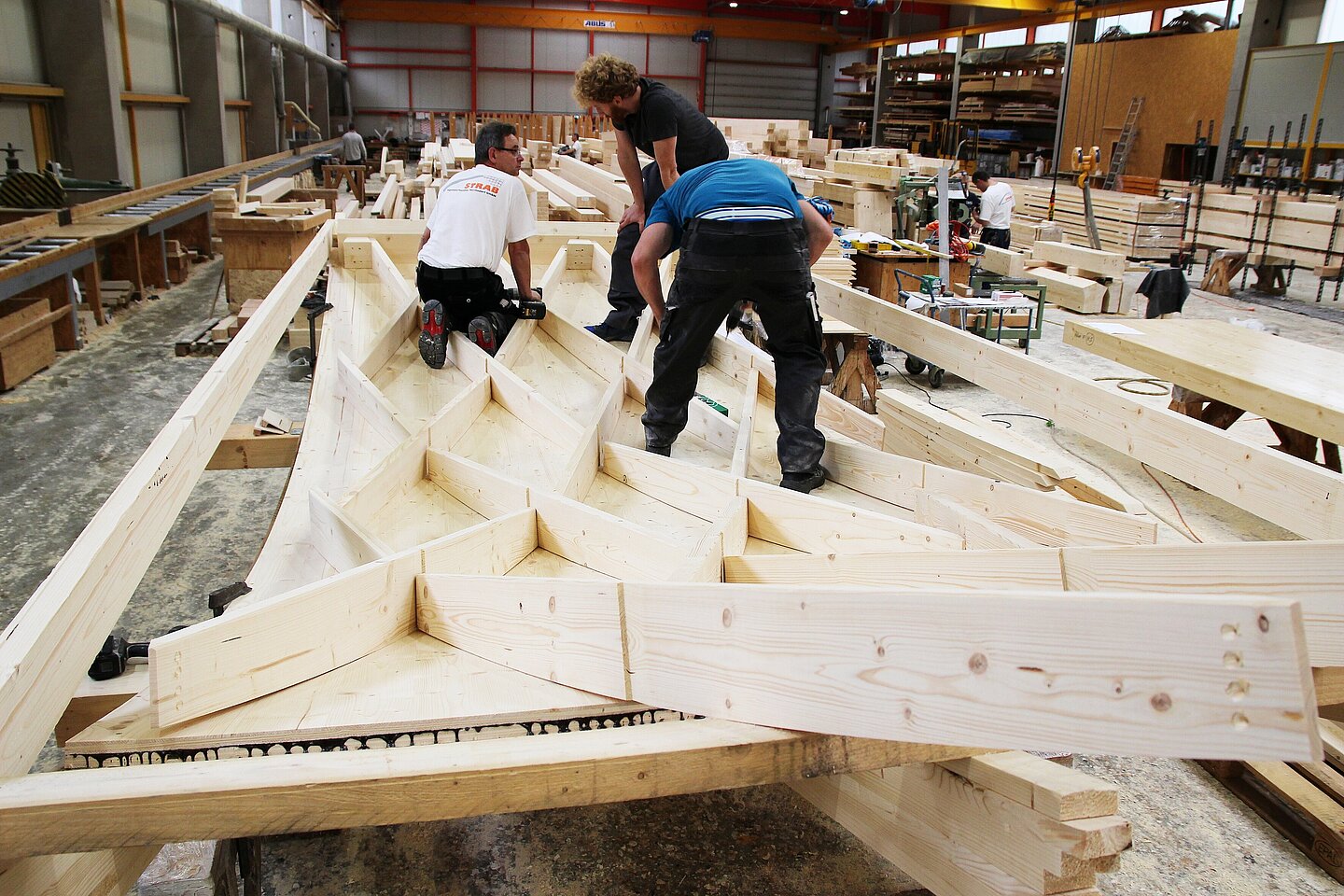
Workshop production of ReFlex-Roof ribbed roofs © FLEX@HTWK Leipzig, Lukas Franke
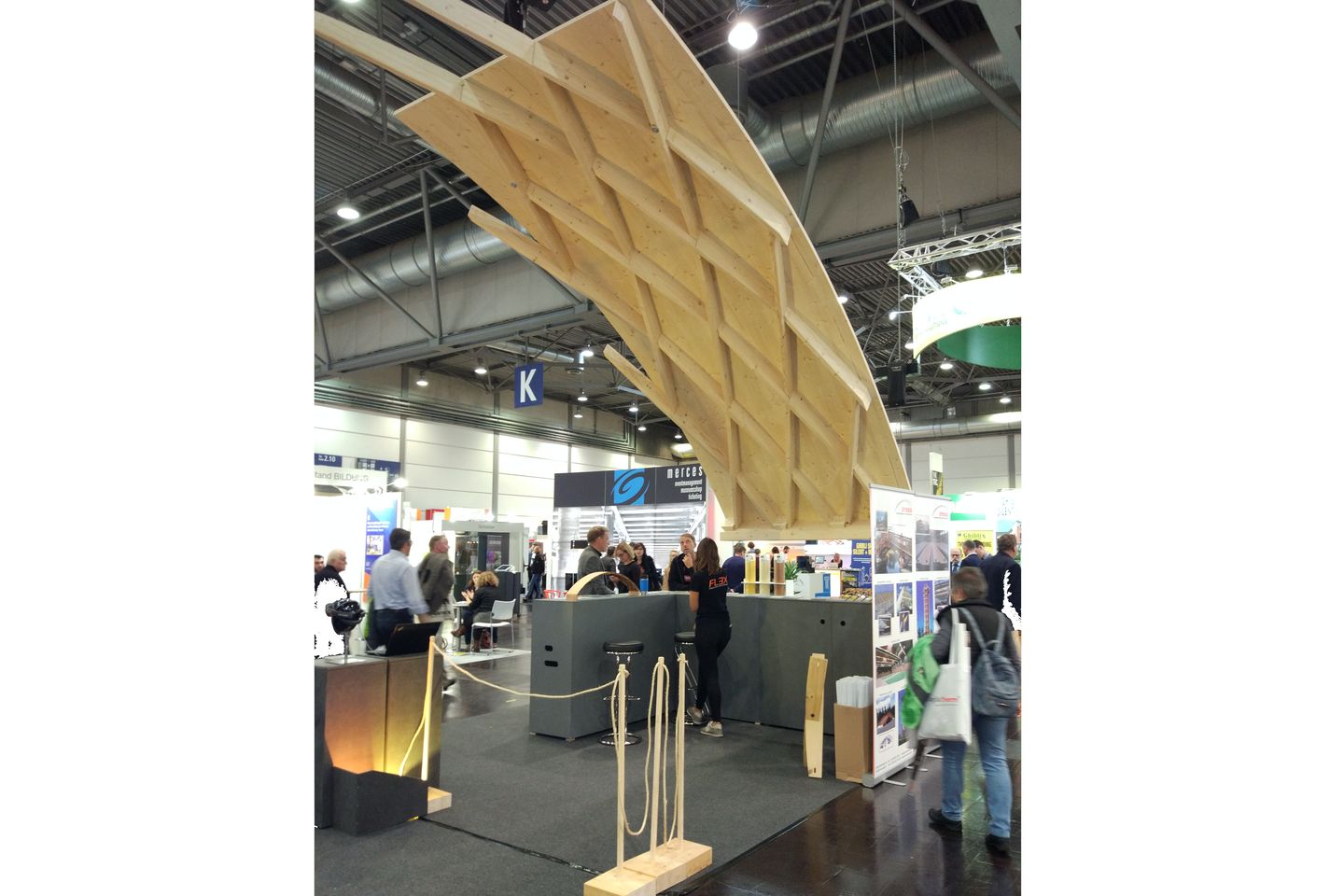
ReFlexRoof demonstrator at the DENKMAL trade fair 2018 © FLEX@HTWK Leipzig, Cristoph Dijoux

Setting up the photogrammetric measurement system for the three-dimensional recording of the deformations of the test specimens © FLEX@HTWK Leipzig, Lukas Franke
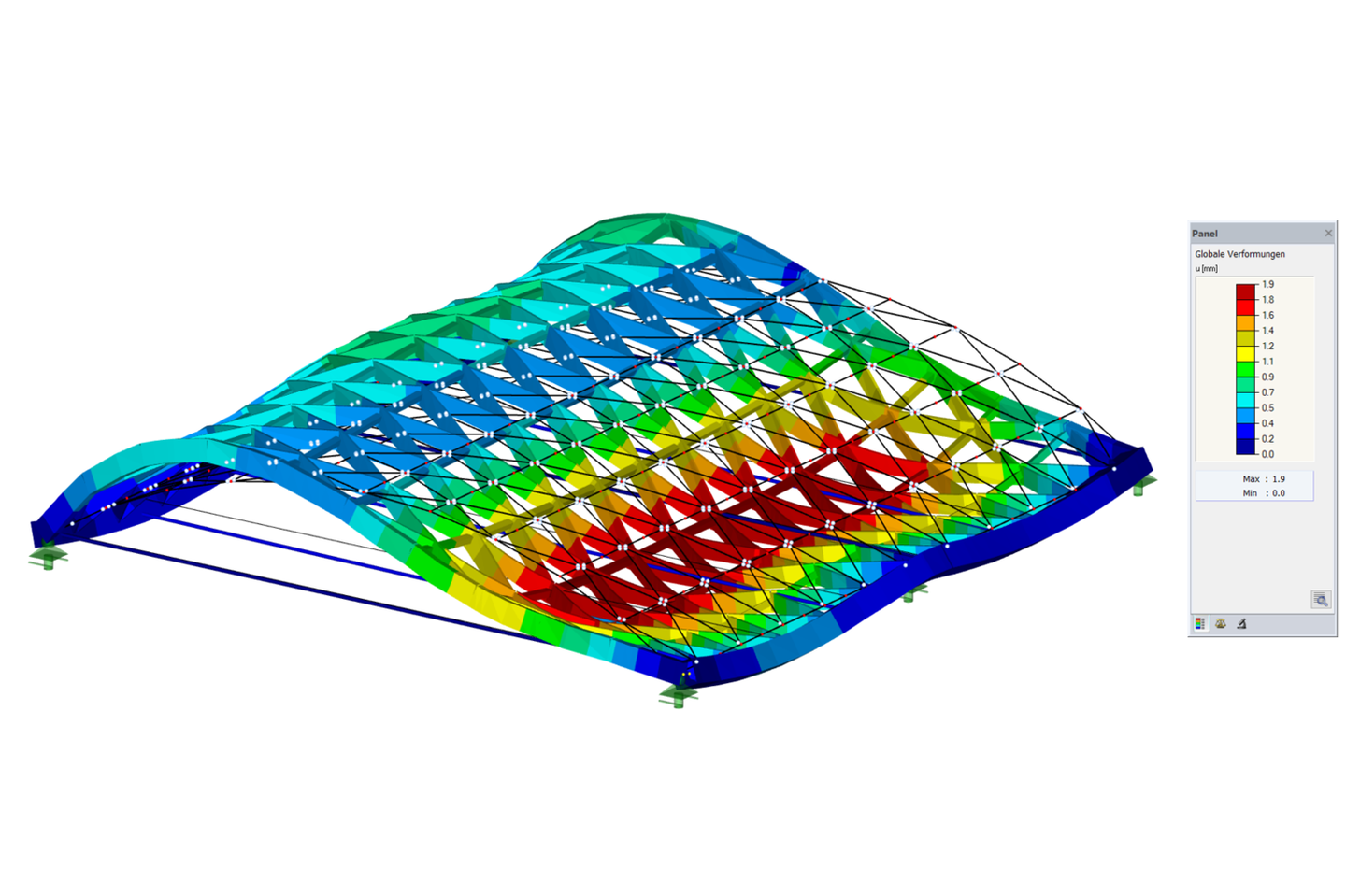
Deformations of the roof structure in the FE simulation © FLEX@HTWK Leipzig, Lukas Franke

Basic concept of the installation process for roofs based on the ReFlexRoof principle. FLEX@HTWK Leipzig, Cristoph Dijoux
The research project focussed on the cost-effective construction of timber ribbed roofs with reduced assembly and construction costs through segmentation. Conventional ribbed roofs were predominantly constructed on site and required full scaffolding of the roof base area, long scaffolding lead times and complex assembly steps. This led to high manufacturing costs and limited the use of such roof systems, which are of high quality in terms of construction and design, in everyday construction largely to prestigious special buildings.
As a solution, a segmented, circular-arched board-ribbed roof construction was developed, in which the production of the roof segments was largely shifted to the workshop. Stackable and transportable arched roof segments were manufactured under workshop conditions, which could be completed into arched roof sections on the construction site and placed on columns or walls by crane assembly. For this purpose, a parametric system was developed to describe the lamella and segment geometry as a function of the base area, system grid and arch stitch and examined in parameter studies with regard to load-bearing behaviour, production effort and assembly economy. A central research topic was the integration of the roof formwork as a co-supporting element, particularly in the construction stage. To this end, large-scale tests were carried out on connection types and load-bearing behaviour.
In the project, FLEX was responsible for generating the parametric geometry model and formulating a consistent data transfer model for use in the structural analysis and in the CNC-controlled production of the louvres and segments. In addition, FLEX planned, organised and evaluated tests to check the calculation results and to ensure the load-bearing capacity of the roof segments. In close cooperation with the project partners, structural variants, joining and bonding details as well as production and assembly processes were analysed, prototyped and evaluated in terms of precision, manageability and cost-effectiveness.
A special feature of the project was the consistently digitally networked process chain from parametric geometry generation to statics and mechanical joinery through to a flexible cost calculation tool that allowed an economic comparison with conventional hall roof systems. The factory prefabrication of transport-optimised segments, ergonomic manufacturing conditions close to the ground and constructively elaborated joining concepts should enable timber construction companies in the hall construction sector to use the ReFlexRoof system as a resource-efficient and competitive roof solution, especially for industrial, storage, sports and event halls.
Keywordstimber construction, roof construction, segmentation, timber frame shells, resource efficiency, board ribs, Zollinger, parametrics, sustainable building
