
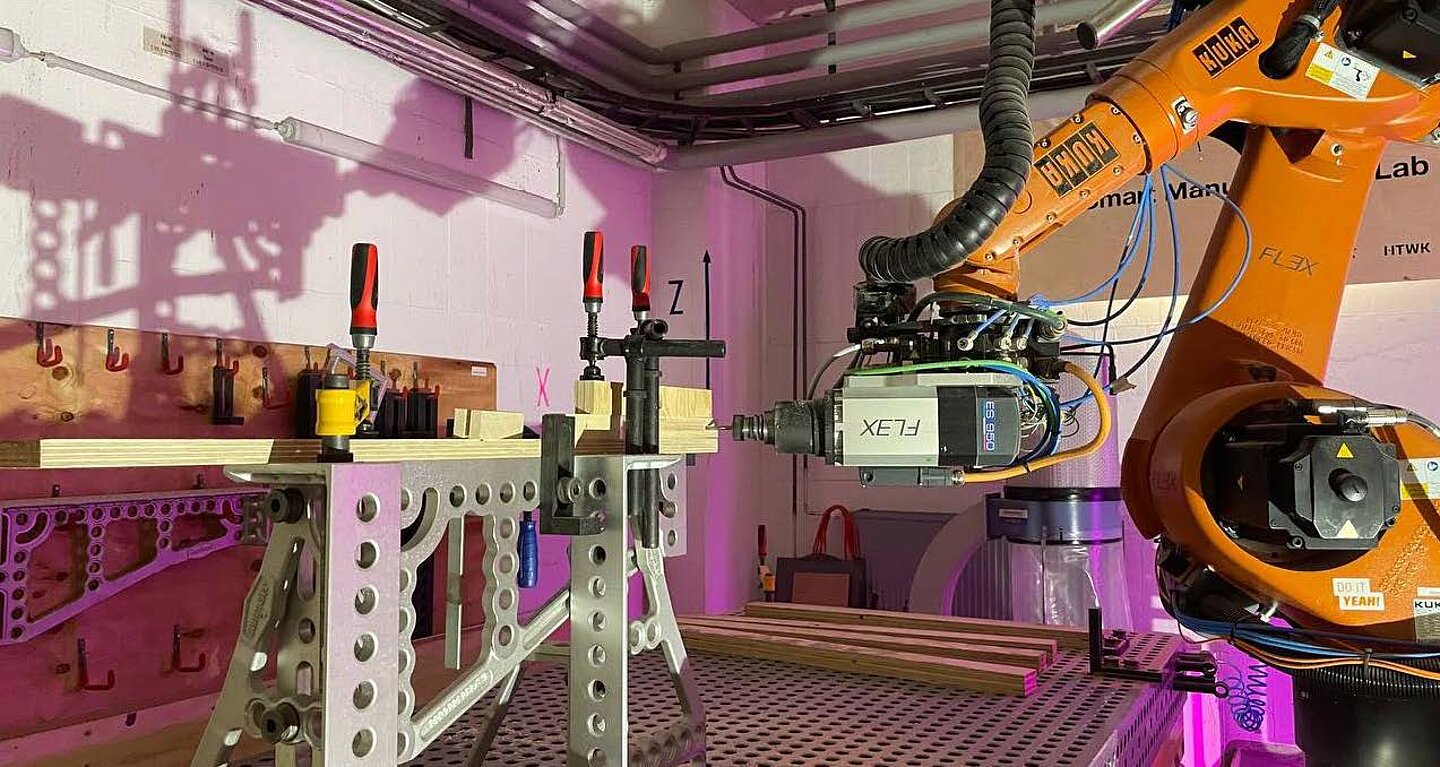
Prototype setup for the robotic production of carpentry-style joints on stylised components; Photo: FLEX@HTWK-Leipzig, Felix Schmidt-Kleespies
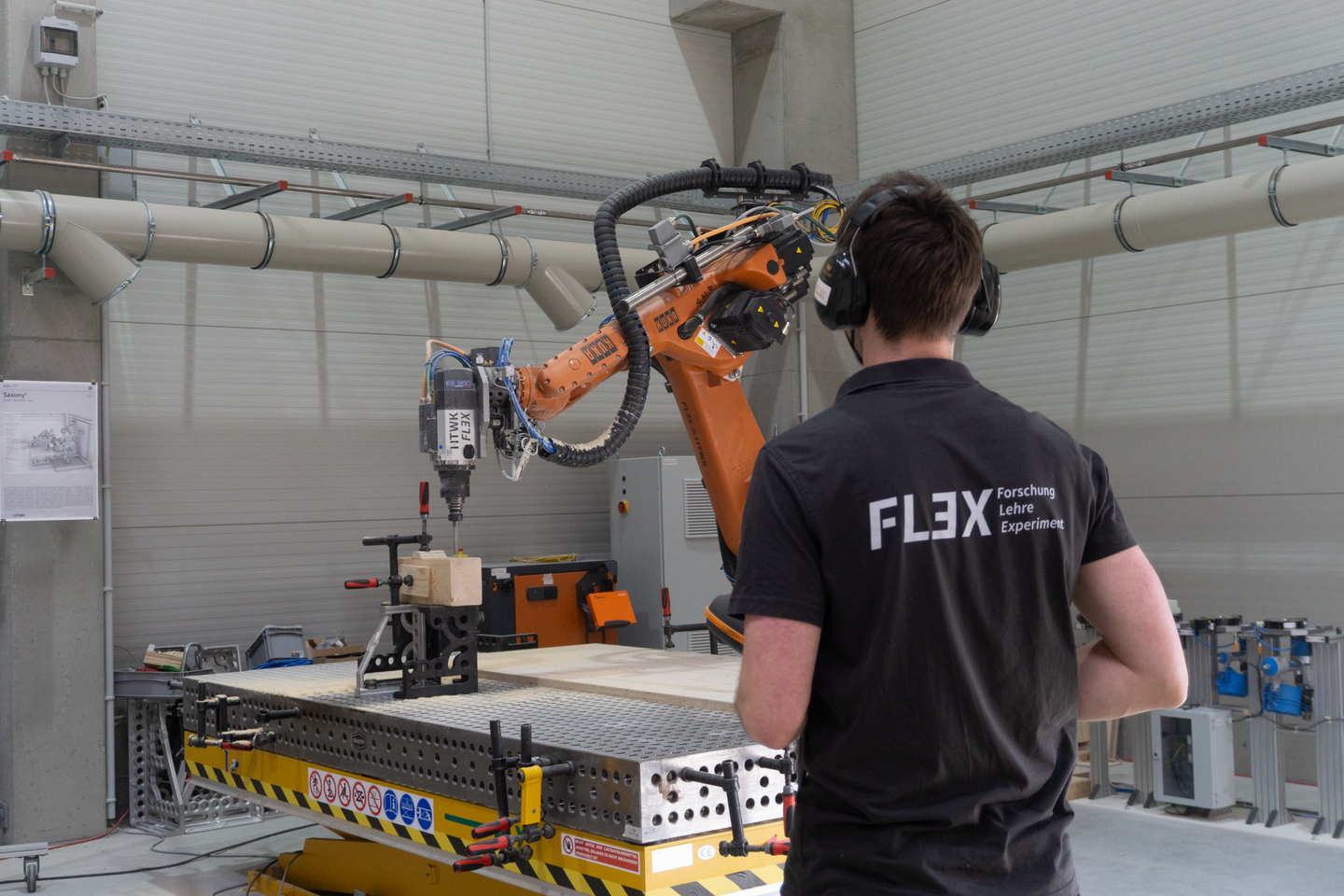
Überwachung des Roboters durch einen FLEX.mitarbeiter; Foto: FLEX@HTWK-Leipzig, Emily Seemann
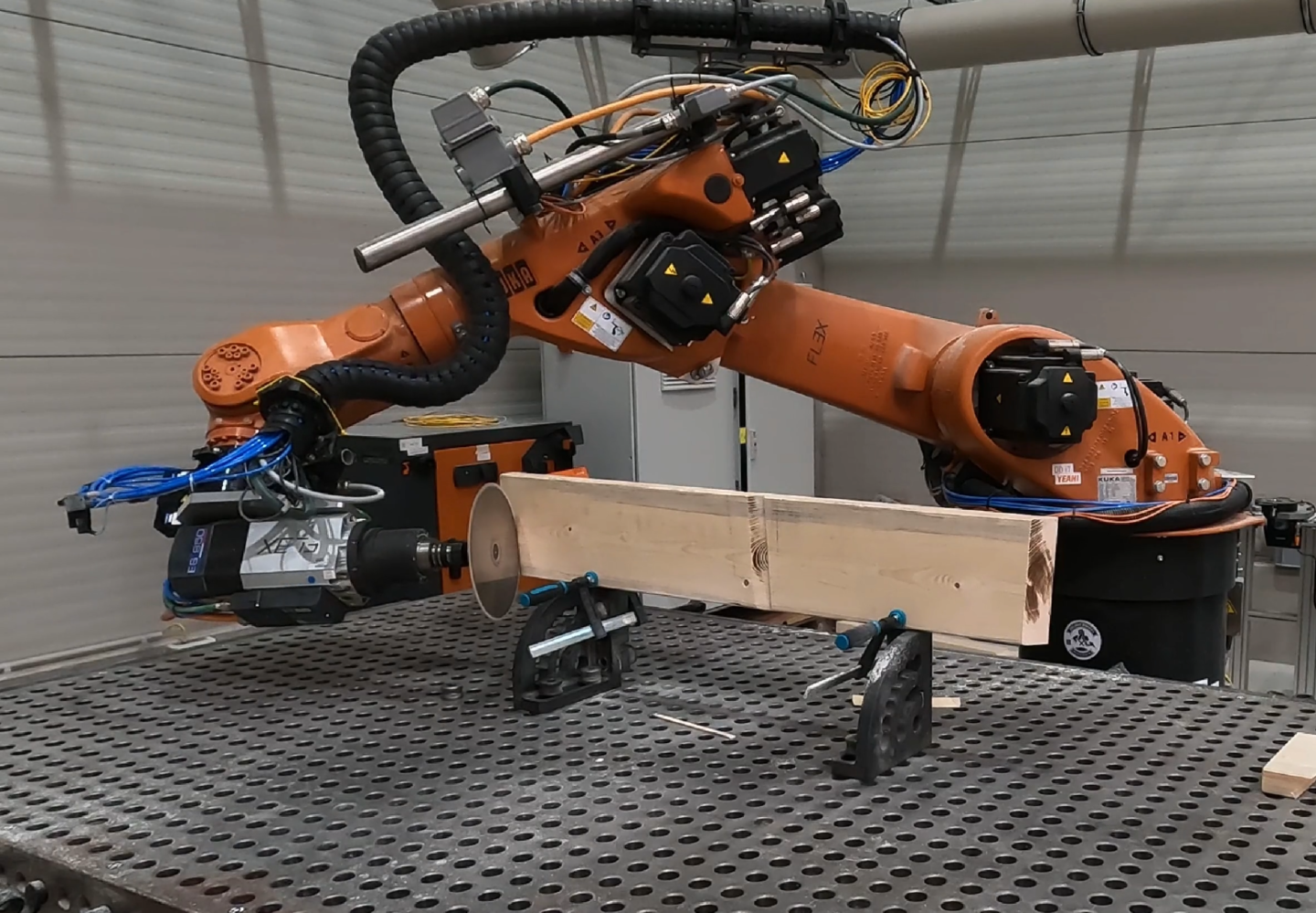
Robotic joinery of a Zollinger slat, photo: FLEX@HTWK-Leipzig
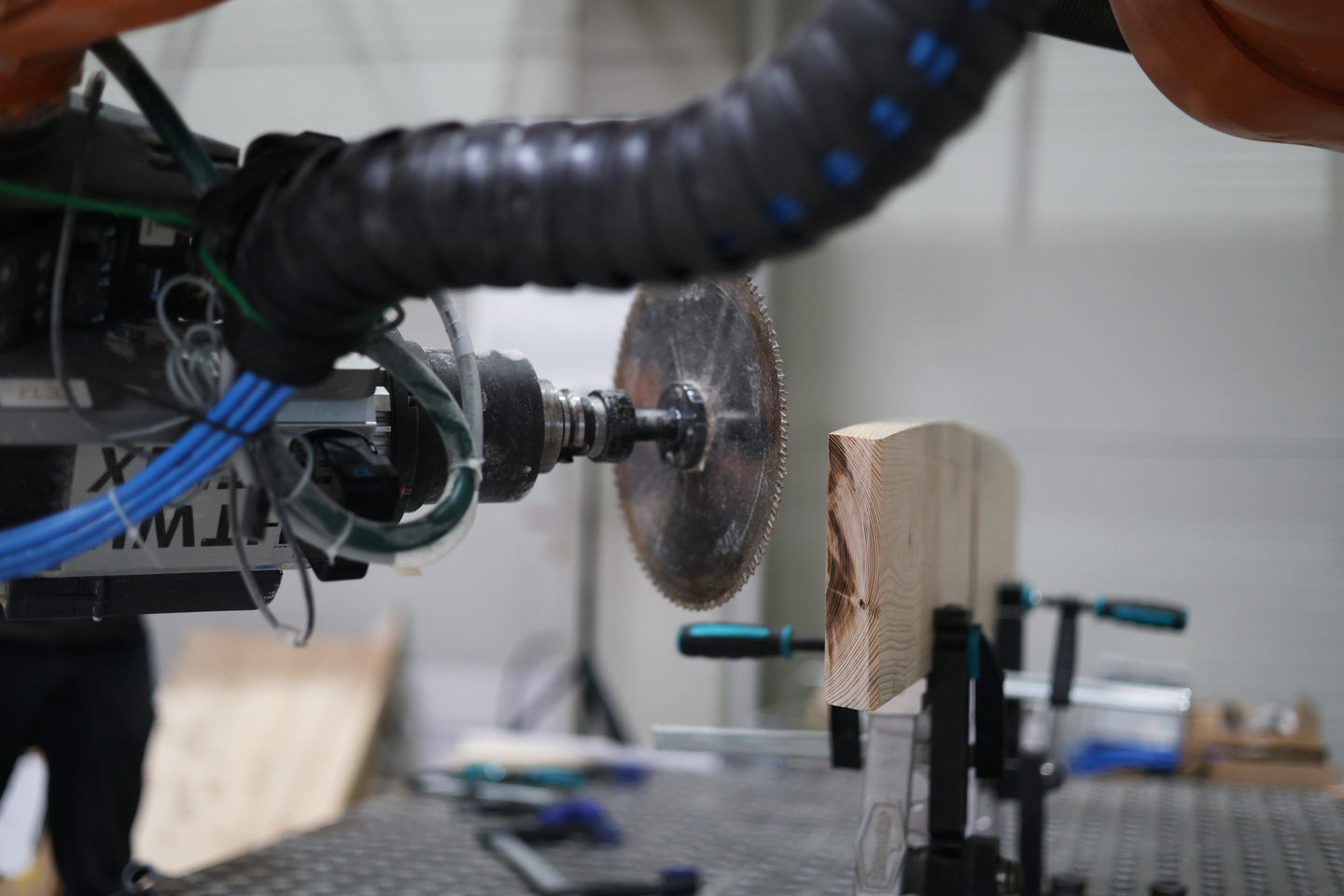
Robotischer Abbund einer Zollinger Lamelle; Foto: FLEX@HTWK-Leipzig, Hannes Löschke
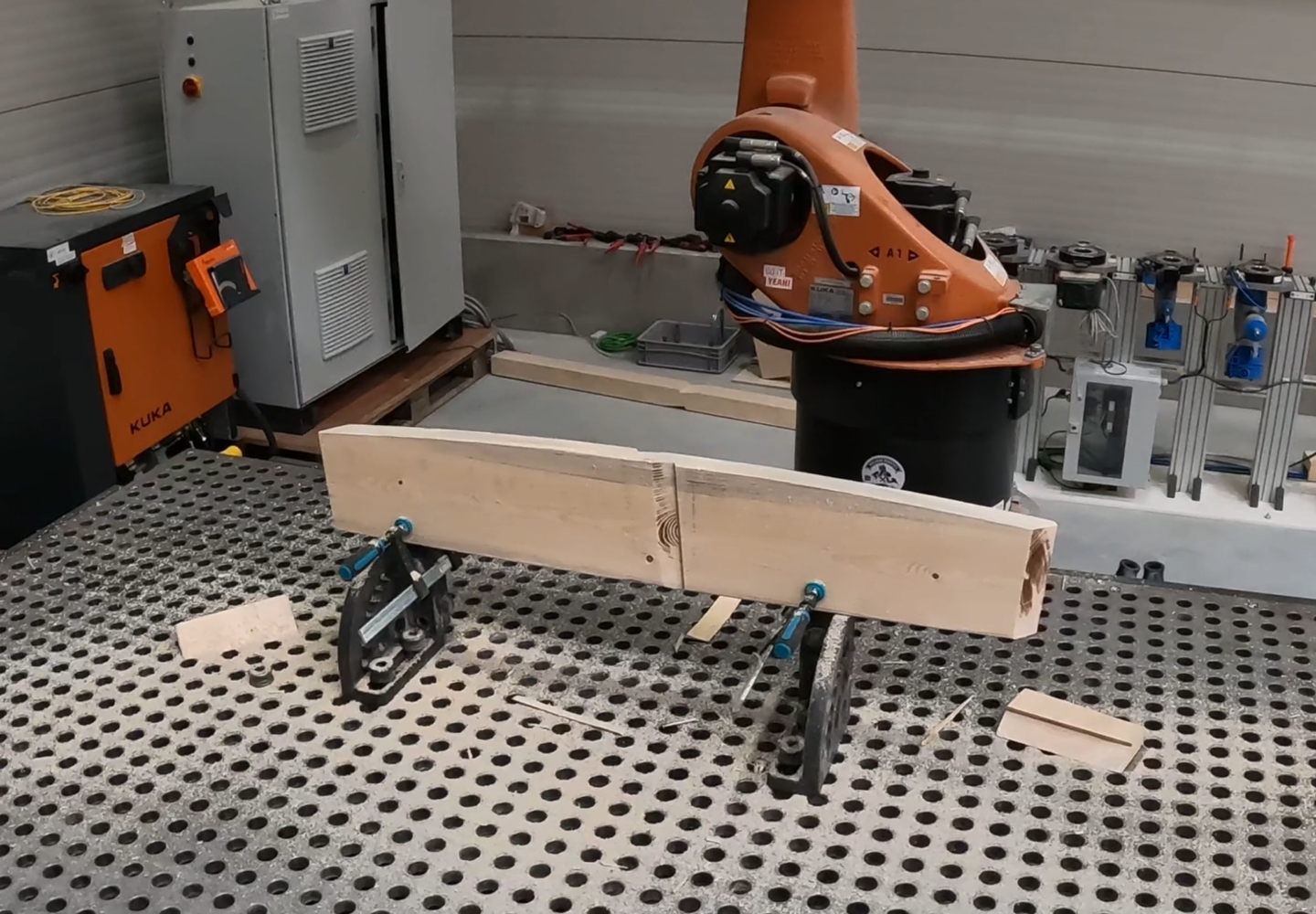
Result of the manufacturing process of a Zollinger slat, photo: FLEX@HTWK-Leipzig
The use of industrial robots in joinery and prefabrication in timber construction has not yet been able to establish itself. However, in the context of its diverse possibilities, the technology offers exciting application-related and economic potential, particularly for small and medium-sized enterprises (SMEs) in the timber trade. Compared to large joinery systems, they are more space-saving, cheaper, more flexible and more versatile.
The "TimberBot" research project aims to develop the foundations for a generative robotic workflow and comprehensive component monitoring in order to enable automated wood joinery based on serial industrial robotics. The cooperation partners of the joint research project are HTWK Leipzig, Chemnitz University of Technology and the Fraunhofer Institute for Machine Tools and Forming Technology (IWU), which is also based in Chemnitz.
The project focuses on increasing the precision of robotic systems and ensuring the necessary positional accuracy of the tools with the help of parallel simulation and compensation approaches. The processes to be developed should enable geometrically highly flexible and at the same time economical production processes. The project is divided into three sub-projects in terms of content and organisation:
- HTWK Leipzig (FLEX): Development of requirement-orientated orientation routines and processing strategies for robotic joinery
- TU Chemnitz (Chair of Production Systems and Processes): Drive-based error compensation to enable robotic systems for prefabrication in timber element construction
- Fraunhofer IWU: Development of process monitoring and management strategies to validate a workflow for the requirements-compliant, digital-based prefabrication of semi-finished wood products and components in timber element construction using robotic systems
The project favours the production of form-fit, metal-free and glue-free connections. This promotes the reuse of existing timber components and significantly reduces the amount of waste material produced in the manufacturing process. At the same time, this type of construction supports the possibility of subsequent cascade utilisation and increases recyclability. The project thus addresses objectives that are also anchored in the German government's timber construction initiative.
The lower space requirement and the reduced logistics of the on-site production process with industrial robots also correspond to an efficient, climate and environmentally friendly use of resources. They therefore focus on a political objective anchored in the "Sustainable Renewable Resources" funding programme of the Federal Ministry of Agriculture, Food and Home Affairs (BMELH). This also includes strengthening the competitiveness of the domestic economy through new and/or improved technologies, processes and products. This "building for the future" is reflected in the integration of robotic systems into the existing production processes of small and medium-sized companies in the wood processing industry.
Keywords: robotics, construction, automation, digitalisation, wood-wood connections
Facts
Project management
- Prof. Dr.-Ing. Alexander Stahr
Project management
- Arne Tischer, B.Eng.
Editing
- Arne Tischer, B.Eng.
Co-operation partner
- PSP / Chemnitz University of Technology
- Fraunhofer Institute for Machine Tools and Forming Technology (IWU)
Supporting companies
- AKE Systemtechnik GmbH
- BENNERT GmbH
- HBS Berga GmbH & Co. KG
- IMHOLZ GmbH | The Behrens Group
- LEIDORF Group
- Leitz GmbH & Co. KG
- METSÄWOOD Deutschland GmbH
- SCHILCHER Trading & Engineering GmbH | X-Fix Holz-Holz Verbindungssysteme
- Mafell AG
Funding organisation
Federal Ministry of Food, Agriculture and Consumer Protection
Project management agency
Agency for Renewable Resources (FNR)
Project duration
10|2025 - 03|2027
Funding reference
2224HV039A
Funding amount
194,012.52 EUR