
IDSMBKS | Interlocking Dowel System Feasibility Study
Innovative wood-wood connection for material-saving wooden panel elements
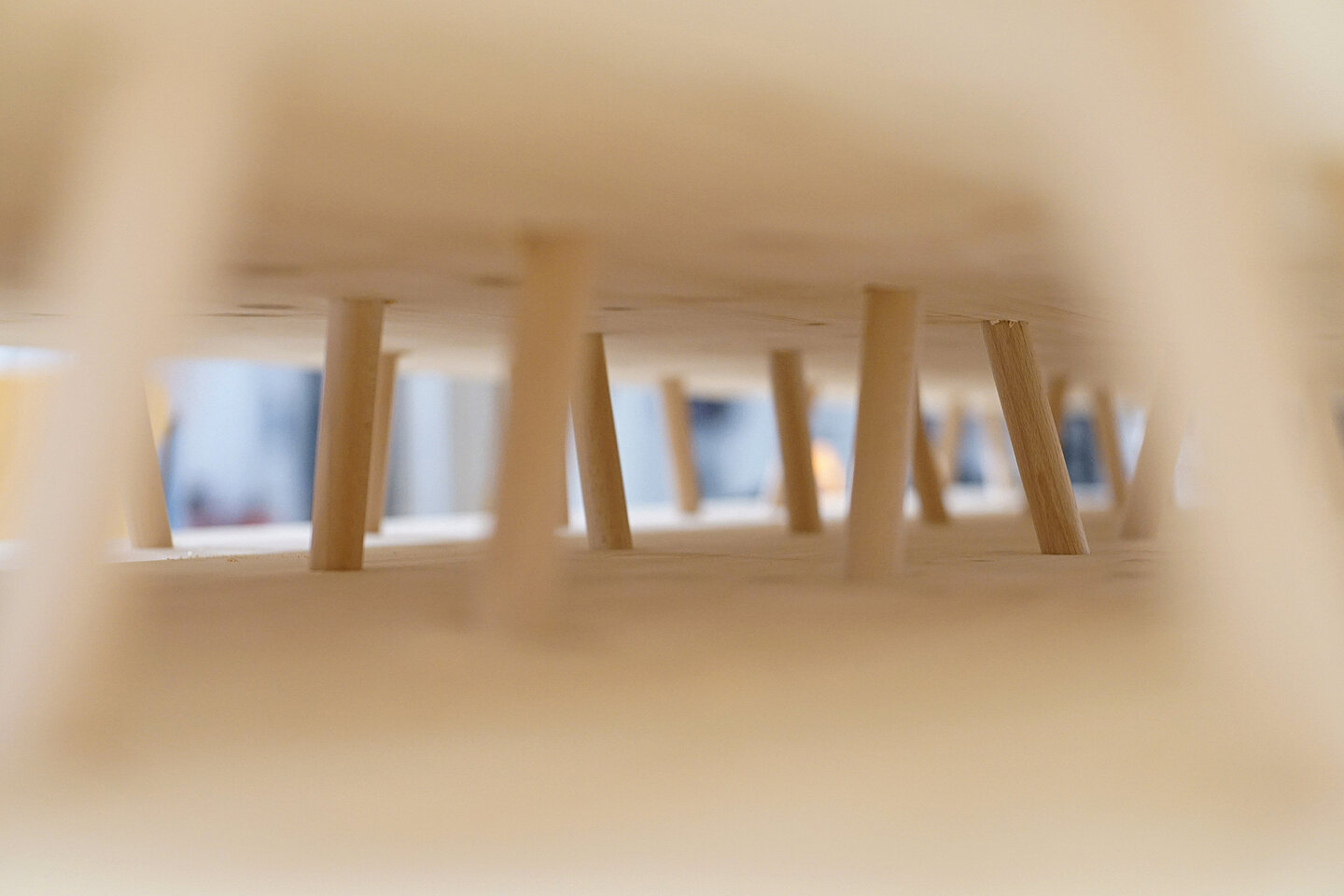
Insight into the wall cavity of an IDS wall element
FLEX@HTWK Leipzig, Felis Schmidt-Kleespies
Test setup for the 3D scan of old wooden beams
FLEX@HTWK Leipzig, Felis Schmidt-Kleespies
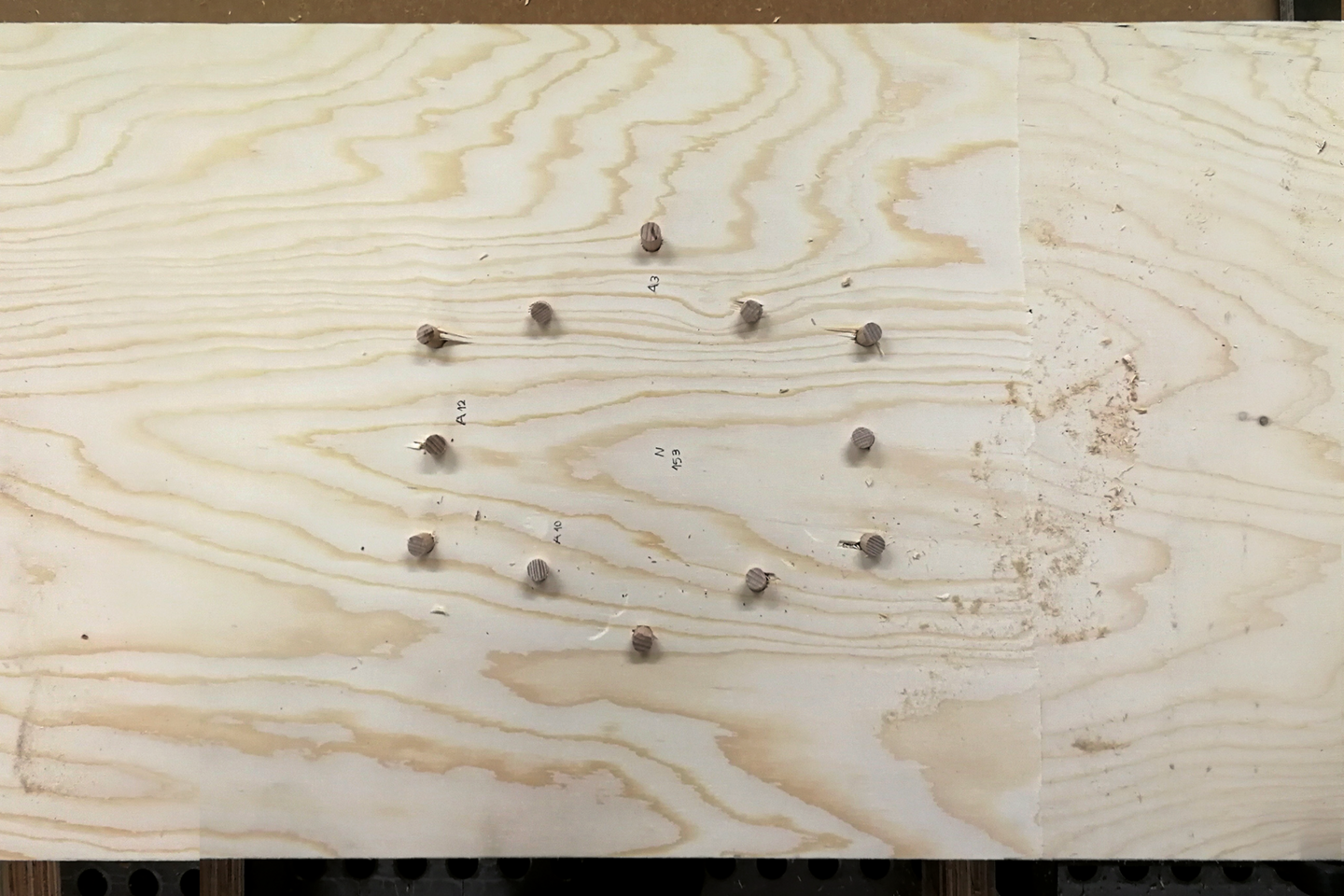
Dowel joints with varying angles of inclination for investigating potential manufacturing-related deviations © FLEX@HTWK Leipzig, Felis Schmidt-Kleespies
The Interlocking Dowel System (IDS) is an innovative, mono-material and resource-saving wall construction system that substantially reduces material consumption compared to established timber construction methods. As, unlike timber frame construction, it does not use solid timber in the core of the structure, its sound and thermal insulation properties are improved. To enable the load to be transferred nevertheless, flat wood-based panels aligned parallel to each other on the outside are connected and statically activated with the help of cylindrical wooden dowels aligned at an oblique angle. The system is also characterised by the fact that its "basic configuration" consists of only two elements (wood-based panels and dowels). The development of form-fit plug-in connections with the aid of load-affine dowel distribution represents a significant step towards eliminating metal fasteners from conventional timber panel construction to a greater extent and, at the same time, speeding up production. IDS elements are based almost entirely on wood and can therefore be separated by type and recycled.
The aim of the IDSMBKS project was to generate scientific findings on the manufacturability and practicality of the innovative timber panel construction method. Despite extensive research and previous studies on the performance and efficiency of the system, it was not yet possible to generate a reliable forecast regarding the suitability of the construction method for use. The technology readiness level of the researched content was previously still at level 2 (description of the application of a technology) and was to be raised here to level 4 (test setup in the laboratory). The envisaged project was able to close this gap and interested companies could thus be persuaded to participate in subsequent full-scale projects.
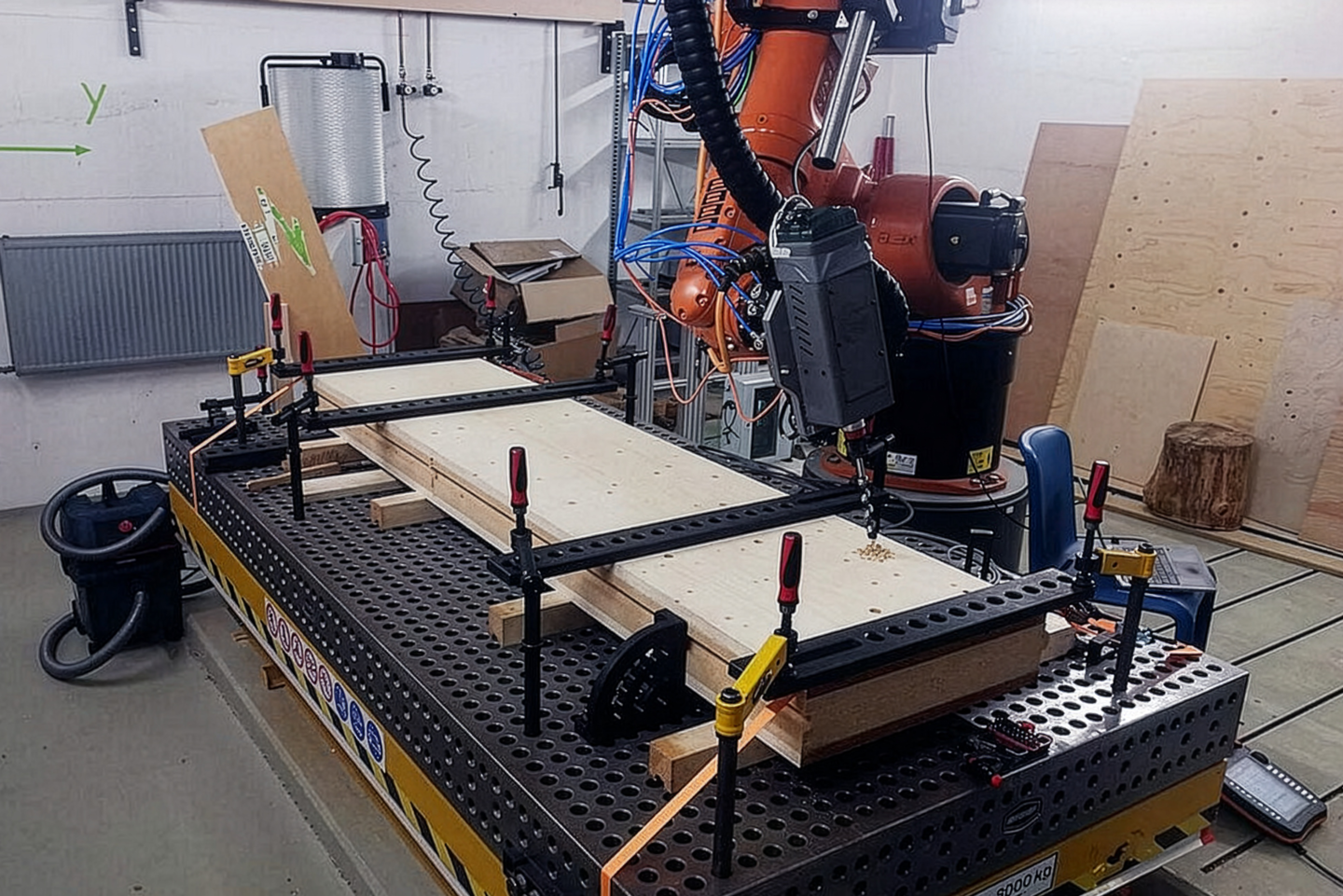
In order to validate the manufacturability of IDS walls in a fully automated, space-saving production process, numerous production trials were carried out in the IDSfeasibility study using a Kuka HA60 industrial robot. These initially included inclined deep-hole drilling, as well as mechanical (based on compressed beech wood nails) and thermal anchoring (using the swelling and shrinkage behaviour of various hardwoods) of individual dowel joints. Real-scale IDS wall components were then produced and the duration of the necessary production steps and tool changes measured. The results of the tests were discussed in high-frequency, recurring project meetings with the practice partners and checked for their practical construction stability.
Keywords: design for manufacture and assembly, form closure, resource efficiency, monomaterial timber construction
Facts
Project management
- Prof. Dr.-Ing. Alexander Stahr
Project Management
- Felix Schmidt-Kleespies, M.A.
Editing
- Felix Schmidt-Kleespies, M.A.
Supporting companies
- Saxon State Ministry for Regional Development (now: SMIL)
- SFK Architekten (PartG mbB)
- Leitner Holzwaren
- BECK Fastening (Raimund Beck KG)
- Tischlerei Weigel GmbH
- SOPREMA GmbH
Funding body
Federal Ministry of Food and Agriculture (BMEL)
Project management organisation
Agency for Renewable Resources (FNR)
Project duration
11|2022 - 05|2024
Funding code
2222HV027X
Funding amount
EUR 123,645 EUR HTWK Leipzig