

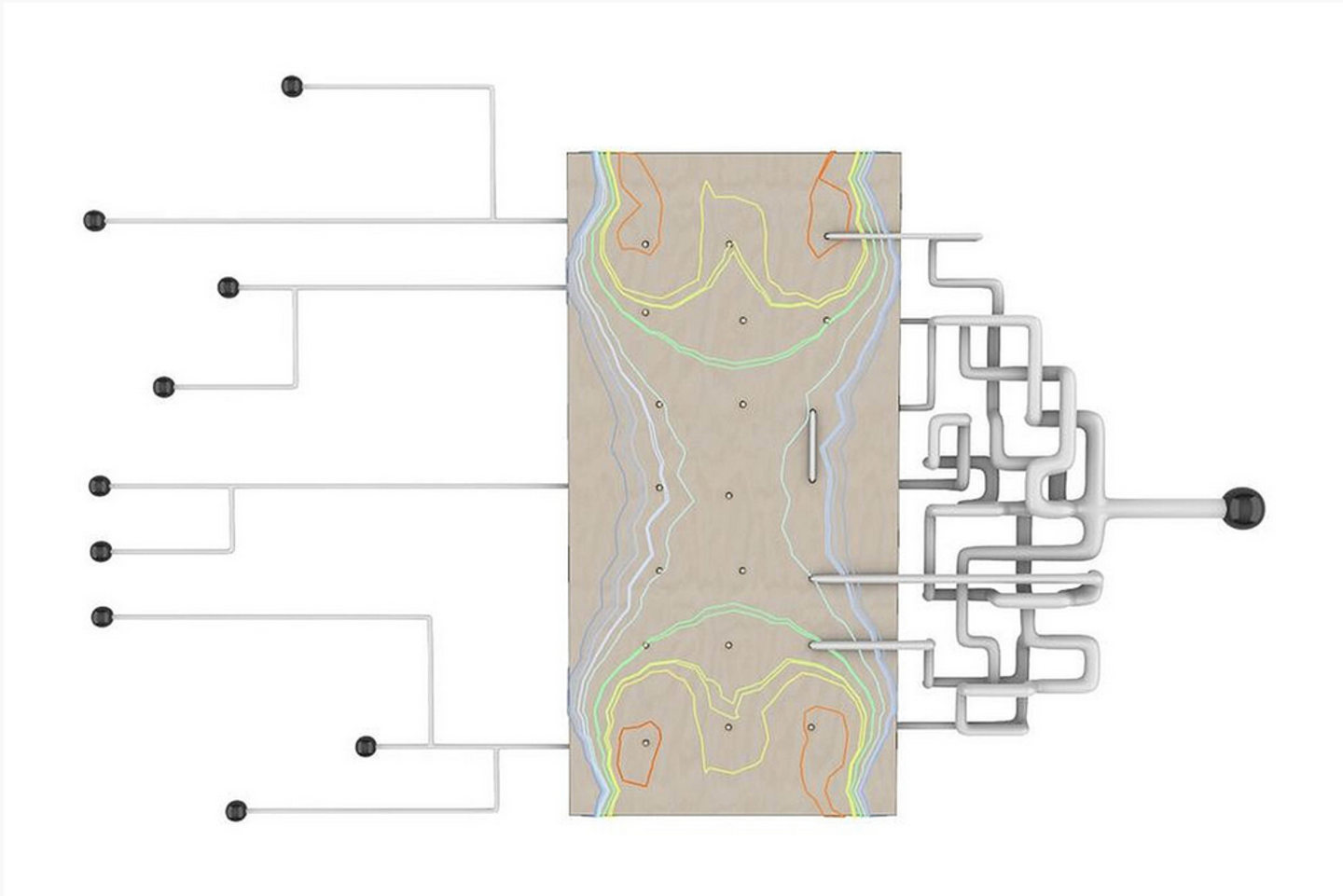
Collage for analysing the flow of forces in IDS walls using neural networks © FLEX@HTWK Leipzig, Martin Dembski
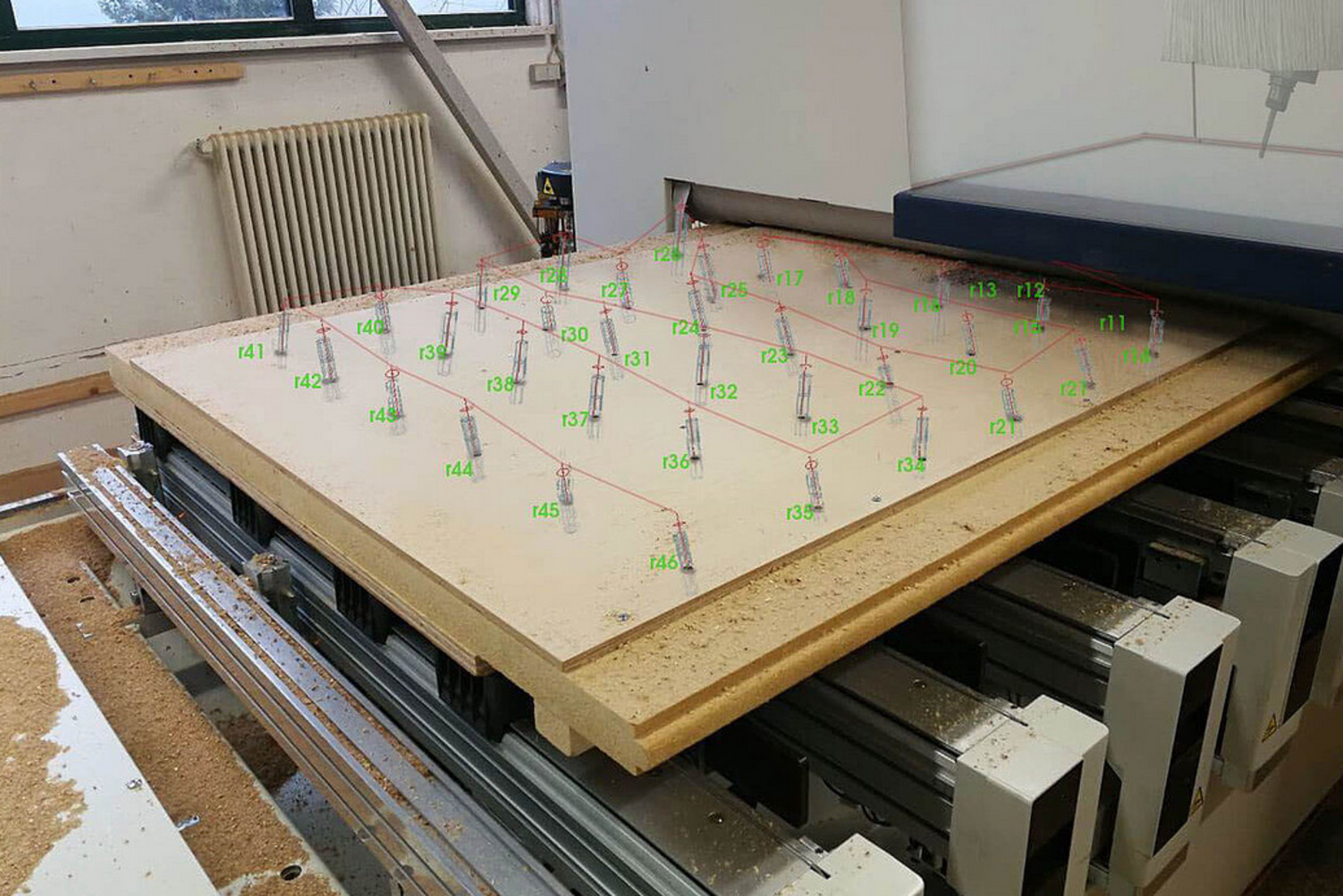
NC gantry machining system with visualised coding of dowel positions and inclination angles on an IDS wall © FLEX@HTWK Leipzig, Felix Schmidt-Kleespies
KI.Assist was a feasibility study on dynamic FE analyses in timber construction funded by the Leipzig University of Applied Sciences, which directly followed on from the IDS feasibility study and was intended to evaluate potential follow-up funding. The project examined the extent to which machine learning (ML) algorithms can be integrated into CAD software and parametric geometry models in order to minimise planning times. ML is used here to infer suitable partial solutions and assemble these into the desired load-affine structures.
The aim of the research project was to replace the previously predominant manual iterative calculation processes in the design of individual timber panels with an ML-supported planning tool. The project was tested using the example of the Interlocking Dowel System (IDS), an innovative, mono-material wall construction method in which load-bearing, flat elements made of wood-based panels are joined using angularly interlocked wood-rod dowels without additional metallic fasteners.
FLEX created data sets for the training of neural networks (agents). The requirement is always that the respective automatically assembled component geometries can withstand the required mechanical loads while minimising the amount of material used. In order to train the AI on a wide variety of possible original geometries, a large number of differently designed components and dowel parameters had to be processed. An initial partial success of the feasibility study is the concept developed for integrating the AI tools into the CAD modelling area of common planning tools. On this basis, a follow-up project to validate the focussed approach could be applied for(TimberWallDesAIgn).
Keywords: Artificial intelligence, AI, timber construction, sustainability, manufacturing, design, planning, building with wood, automation, dowel connections, prefabrication
