
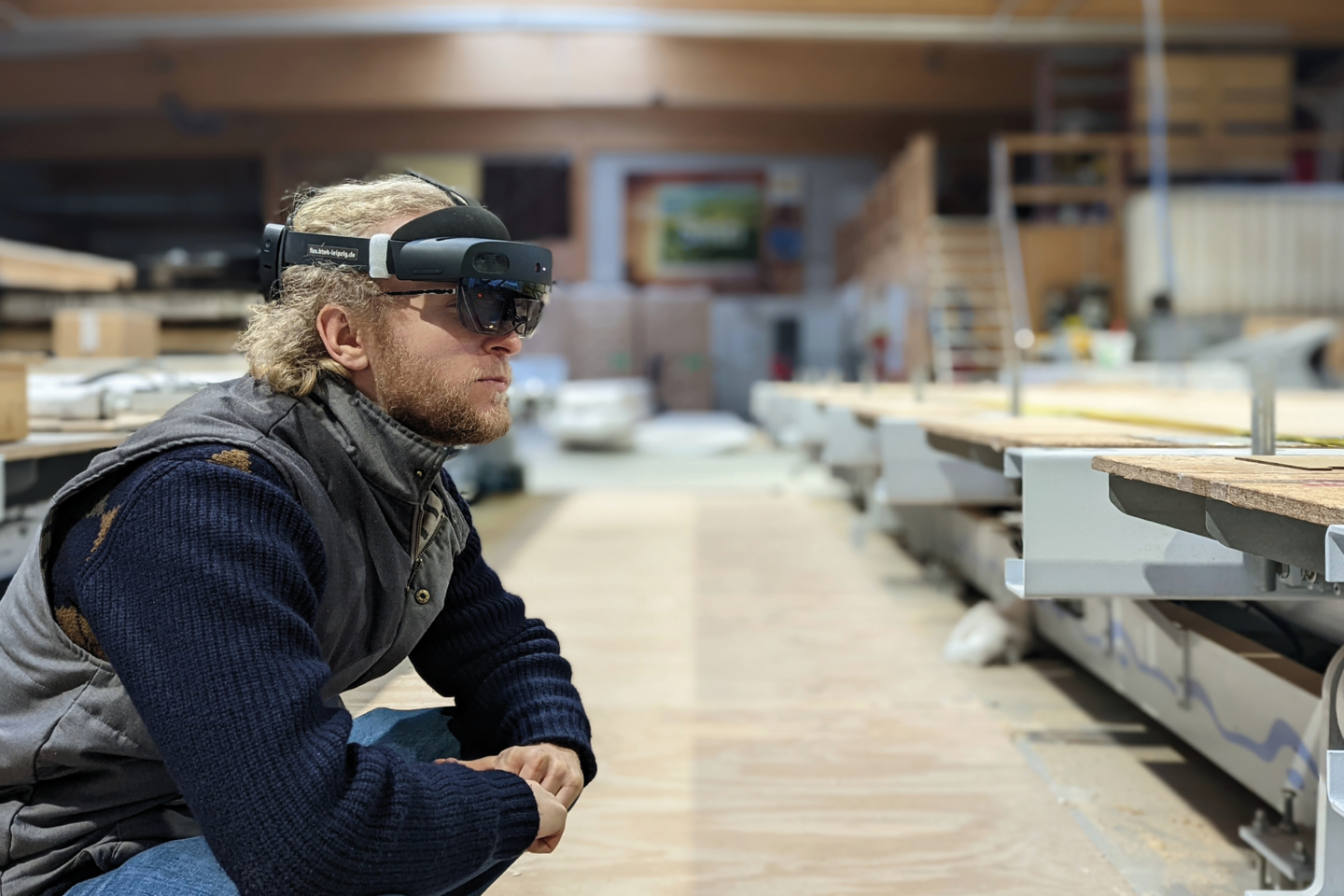
Hololens 2 as a tool for extending the digital information chain © FLEX @ HTWK Leipzig, Felix Schmidt-Kleespies
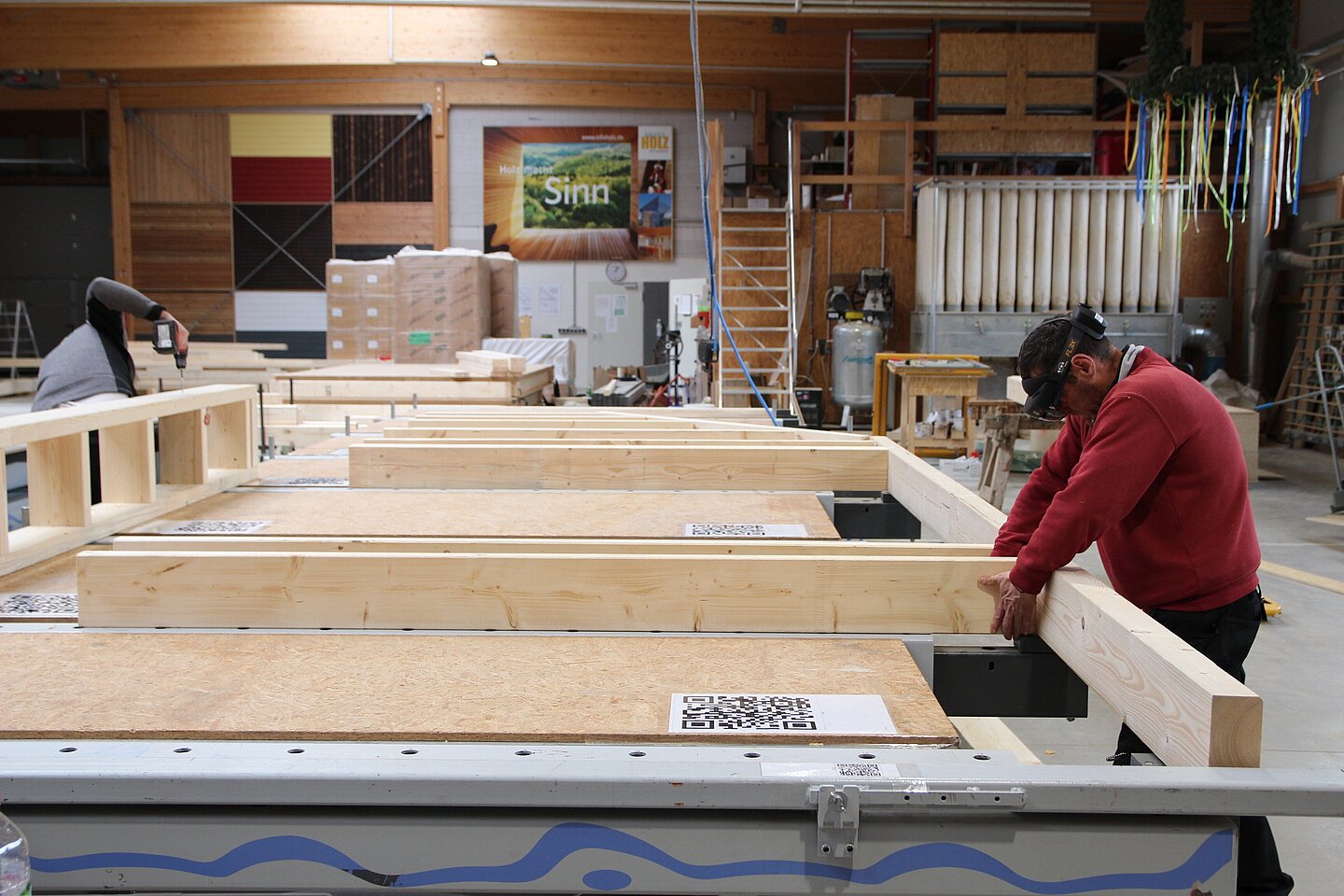
A worker fitting a handle to the component outline visible to him, © FLEX @ HTWK Leipzig, Cristoph Dijoux
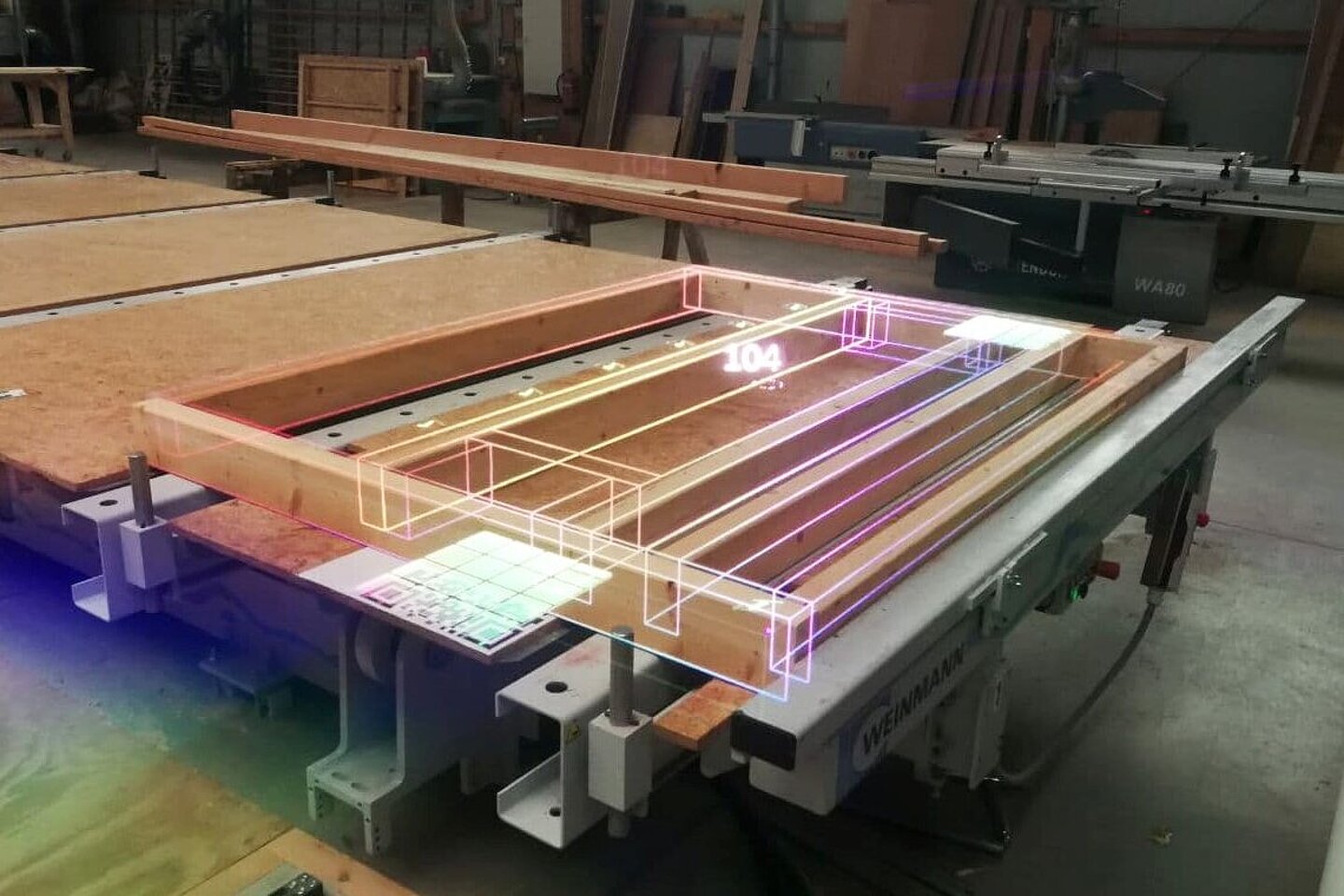
Projection of a test specimen with the studwork in place, © FLEX @ HTWK Leipzig, Felix Schmidt-Kleespies
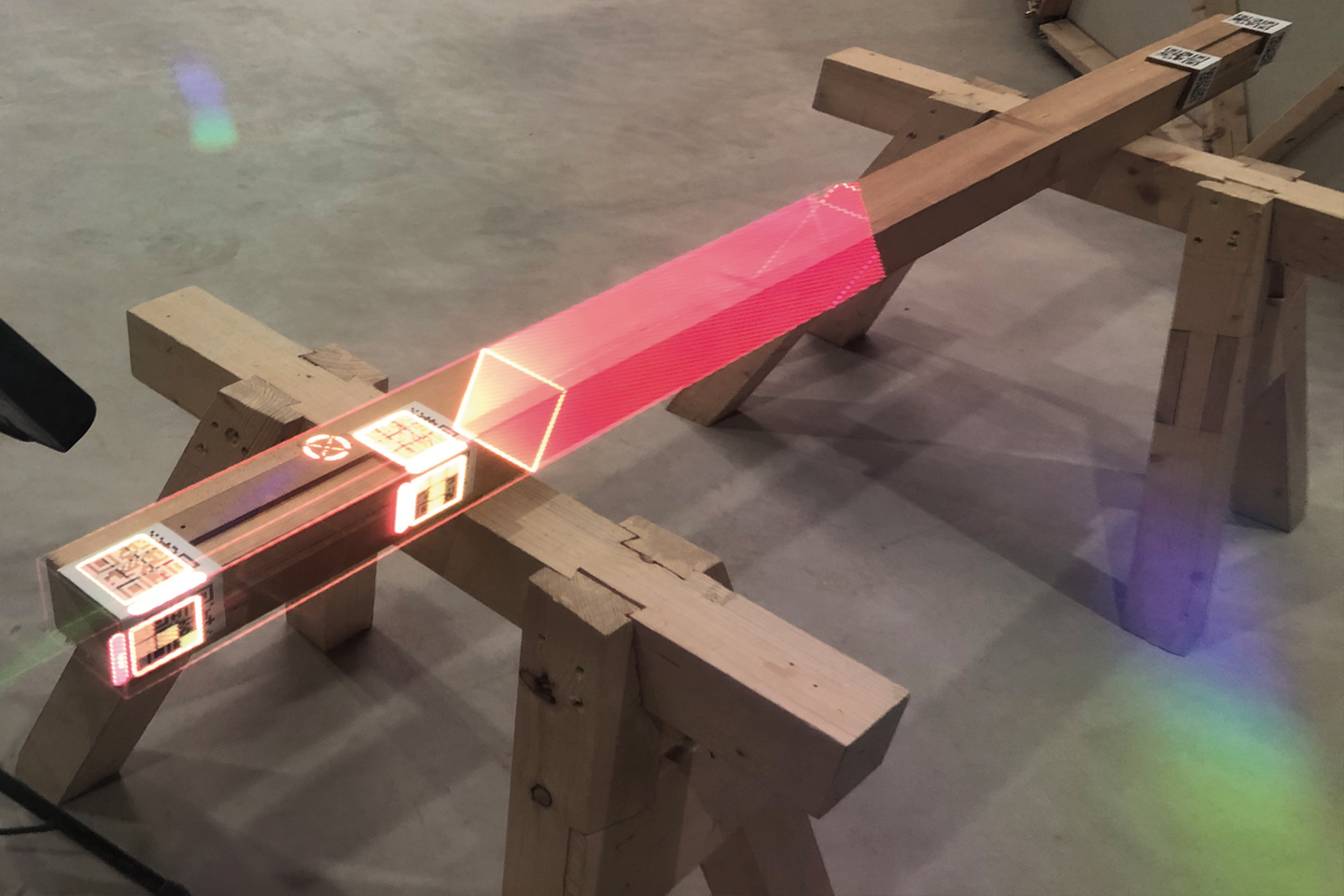
Capturing an image of a beam using localisation markers © FLEX @ HTWK Leipzig, Felix Schmidt-Kleespies
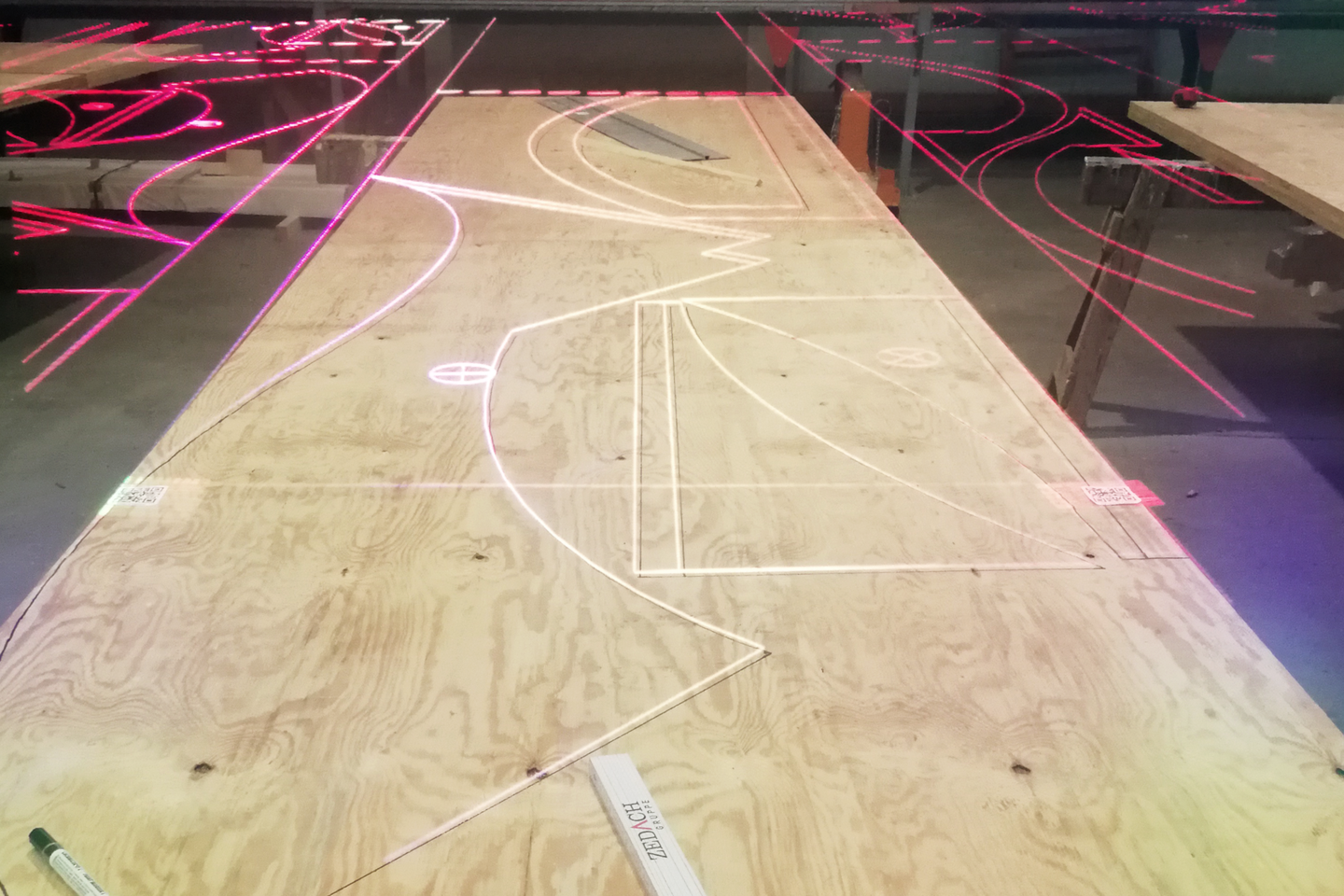
Projection of the external contours of a component for the construction of a bat dormer, © FLEX @ HTWK Leipzig, Felix Schmidt-Kleespies
Medium-sized timber construction companies often use a timber panel construction method in multi-storey building. This is based on a high degree of prefabrication. In principle, large (automated) production facilities and machine parks are not necessary for this. However, there are companies on the market that can exert significant price pressure by automating production using gantry-type machining centres. Such large-scale equipment entails substantial investment costs that are beyond the means of small and medium-sized enterprises. For manual production, however, the complex requirements (structural integrity, thermal insulation, sound insulation, etc.) of timber panel construction entail considerable effort, which must be implemented within a reliable production process.
OptiPaRef aimed to increase production efficiency and process reliability in the craft-based manufacture of timber-frame building components. The core idea of the project was to make the three-dimensional design data – which is generated anyway – available to carpenters directly on the shop floor, step by step and in a context-sensitive manner. To this end, FLEXdeveloped a methodology for the holographic display of complex production information for individual components (see Figs. 3 to 5). Augmented reality glasses serve as the tool for extending the digital information chain from workshop planning through to production (see Figs. 1 and 2). The assistance system being developed projects the necessary production information directly into the carpenter’s field of vision without any additional effort. At the same time, quality assurance during production is significantly simplified.
In this research project, FLEXanalysed the working methods of the project partner Holzbau Lepski and developed tools that enable the digital information chain to be extended into the production process. The Hololens 2 used for this purpose provided the basis for the development of AR tools, designed, on the one hand, to make the digital data directly and intuitively available to carpenters whilst they are manufacturing the panels, as well as measurement tools capable of determining distances and angles with a simple finger tap, and an interface enabling efficient, paperless recording of the production process. At the same time, methods were developed to ensure dimensional accuracy, orientation and localisation of the worker and their surroundings (see Fig. 4).
Keywords:timber construction, craft-based fabrication, augmented reality, CAD-CAM, quality management, parametric design, HoloLens 2, component referencing
Facts
Project Management
Project management
Research
Collaborating partners
Funding body:
Federal Ministry for Economic Affairs and Energy (BMWE)
(Central Innovation Programme for SMEs)
Project management organisation
VDI/VDE Innovation + Technik GmbH
Project duration
06|2021 – 11|2022
Funding reference number
16KN094625
Funding amount
219,180 EUR